Saturday, July 5, 2014

Happy 66th Birthday to NHS Scotland

Happy 66th Birthday to the NHS in Scotland! While the NHS is great at treating illness, the greatest health challenge in Scotland is health inequality. That requires coordinated action across our public services.

To commemorate this birthday, UNISON Scotland has published a paper on health inequalities in Scotland. I drafted this paper as our submission to the Health Inequalities Review commissioned by Neil Findlay MSP. The review starts from the premise that Scotland’s health inequalities are the unjust differences in life expectancy and these differences are determined by socio-economic position, caused by the unfair distribution of income, wealth and power. Tackling this inequality is arguably the greatest challenge we face as a society.

Overall life expectancy has increased in Scotland in recent years, but continues to be closely associated with deprivation. The average life expectancy of men living in the least deprived areas remains around 11 years higher than in the most deprived areas. There have been many reports describing this problem, but less focus on solutions. That's why this paper focuses on policy recommendations that we believe could make a real difference.

We start with the structural changes that are needed to break down silo working. We need to assess every policy against national indicators on health inequality, but it is at local level, working through Community Planning Partnerships where joined up working needs to become a reality. As Christie recommended, staff and service users should be fully engaged in delivering positive health outcomes.

While health inequality requires cross service action, that doesn't mean we should ignore health actions. The paper sets out a range of actions that address public health concerns around smoking, drugs and alcohol. Social care in Scotland is a national disgrace and much more needs to be done on improving mental health. We also need to ensure that NHS resources are targeted on areas of greatest deprivation. The NHS must be at its best where it is needed the most.

Finally, we set out a range of broader actions. These include action in the workplace through occupational health, health and safety, and measures to tackle worklessness. Improving our environment through design, better housing, sustainable transport policies, as well as measures to tackle climate change. Preventative spending should be at the core of our approach with quality early years provision, followed throughout the education journey to further and higher education.

Eradicating fuel poverty is vital to health inequality. That means raising incomes, freezing energy prices and effective energy efficiency measures. UK child poverty rates are predicted to rise to 24% by 2020, resulting in an additional 50,000 children in Scotland living in poverty. So welfare reform and increasing wages are an essential element of this strategy.

A comprehensive strategy starts with a recognition that health inequalities are caused by socioeconomic inequality. Building on that analysis, we must take action to narrow wealth and income inequality, not just increasing income at the bottom. Other actions require a new structural approach that places health inequalities at the centre of public policy, leading to a range of practical measures that can alleviate and then eradicate health inequalities.


Dave Watson

Monday, June 23, 2014

Scots continue to support a public NHS

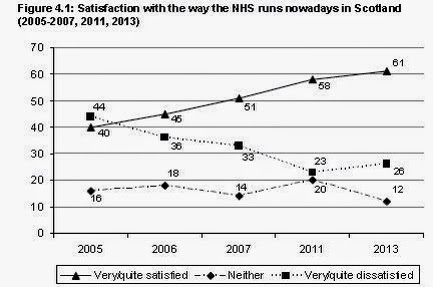
Public satisfaction with Scotland's NHS continues to rise, while support for privatisation falls.

New findings from the Scottish Social Attitudes Survey (SSAS) 2013 have found satisfaction with Scotland’s NHS increased by over 20 per cent since 2005. The official survey of around 1500 Scots found that 61 per cent of people in Scotland were either very or quite satisfied with the NHS, compared with only 40 per cent in 2005. This high level of satisfaction is reflected in the patient experience as well. In last year’s Health and Care Experience Survey, 85 per cent of Scottish inpatients say their overall care and treatment was good or excellent, and 87 per cent also rated the overall care from their GP surgery as good or excellent too.

The survey authors also speculate that the reduction in NHS satisfaction levels in the UK since 2011 may be due in part to concerns about the organisational reforms in the English NHS following the introduction of the Health and Social Care Act in 2012

Scots also continue to reject the marketisation of care. In this survey, the majority of people (59 per cent) also thought the government would provide better quality care services than the private sector. There has even been a drop in support for charities running care services. It was always low for hospitals and very low for the private sector. Private sector involvement in the NHS may be minimal in Scotland, but it is common in the social care sector, particularly residential and home care.

This survey shows that opposition to the marketisation of health and care remains strong in Scotland and that most Scots believe that cooperation is the best way to run our NHS.


Wednesday, May 14, 2014

Pfizer, AstraZeneca and why we need a publicly owned pharmaceutical option

As a biomedical scientist myself, I was very interested to see that the US pharmaceutical giant Pfizer is trying to take over the UK pharmaceutical giant AstraZeneca. As a skeptical socialist I assumed that the reason behind this was to take advantage of our corporation tax rate of 21% which is substantially lower than the US rate of 35%. However, what really got my attention was that policy makers are worried because they understand that if this deal goes through, the UK would lose one of its few world-class companies and more specifically its jobs and investment. This seems a well founded worry as Pfizer reduced R&D expenditure from $9.4 billion in 2010 to $7.8 billion in 2012 and involved the infamous closure of its laboratories in Sandwich, UK.

However, I see a much bigger problem in investment across the whole pharmaceutical sector caused by excessive financialisation. Fuelled by the perception that corporate reorganisation could provide quick returns for shareholders, pharmaceutical companies have attempted to increase profits through mergers, acquisitions and tax evasion, with the net effect of a reduction in total expenditure on R&D. In fact when Imperial Chemical Industries (ICI) demerged in 1993, the pharmaceutical business was merged with the Swedish company Astra to form AstraZeneca but the chemicals and electronics successor companies carried out R&D at a much reduced level.

My argument is that successful, long-term R&D, which produces pharmaceutical products that benefit society and contribute to long-term economic growth, lowers profit in the short term but then provides income streams to fund further research and growth in the long-term. It is not even the case that investors could claim that, the pharmaceutical sector has not consistently delivered high margins and high growth. However, the market failure here is why I feel we need to create a publicly owned option.
Science policy is very political and ideas that can be traced back to Friedrich Hayek float around suggesting that science is a force that cannot be steered and evolves in response to the demands of the market, in an almost Darwinian manner. I admit that this is probably the case in R&D with low barriers to entry, like someone in their bedroom developing an app for a mobile phone. However, it takes on average 9 years and $2.17 billion of R&D spending to produce a single new drug (including the cost of all the failures) in the pharmaceutical industry.

Industrial policy fell out of fashion in the Thatcher revolution, however, post-Thatcher I would really like us to start making a case that the pharmaceutical sector should be planned and directed towards growth and solving the problems of society. Successive governments have asserted the promotion of economic growth as the primary goal of science policy and that is fine but in the past the state has sponsored companies like ICI with guaranteed contracts or monopolies.

The outlays for start-ups in this sector are huge and venture capital money is hard to get. There is also too much focus on the role of small and medium sized enterprises (SME) to drive innovation and in the UK only 3.5% of R&D was carried out by the independent SME sector. Large organisations are required.

The state and the non-profit sector provide massive amounts of R&D funding which largely goes to universities. We can attempt to correct market failure by giving money to companies, through R&D subsidies, tax concessions, patents or even cash prizes but at the end of the day, the state is supporting expenditure that the companies should be making anyway and there is no guarantee that the UK will retain benefit.

Resistance to innovation also comes from representatives of incumbent economic interests.
Incumbent capitalists have lower incentives to invest in R&D than new entrants as innovation causes a lowering of profits from their existing businesses. Perhaps our political system that gives excessive weight to the holders of economic power, is putting a brake on R&D even though it would be beneficial for society?

The fundamental problem is that the social value of producing new drugs does not correspond with their market value, so there is no financial reward for undertaking the R&D that society needs. I personally feel that the state should directly commission the R&D that society needs but the neoliberal dogma is that governments ‘can’t pick winners’. However, I feel that answer lies not in a board of ex-ministers, peers and professors but in an open question to citizens about what innovations are needed? Yes, choices should be underpinned by evidence and include expert advice but democracy should be at the centre of what kind of future people want and what resources we put in to get there.

Our changing age demographic and life expectancy is greatly welcomed and I feel if asked, citizens would like greater resources concentrated towards the ends of their lives. Dementias have no effective treatment and leave increasing numbers of our population and their relatives and carers suffering. It is in this context that the reduction in R&D in the pharmaceutical industry is particularly worrying.

In conclusion, if the government is able, it should stop Pfizer taking over AstraZeneca. However, that still does not tackle the greater problem of the reduction of R&D within the pharmaceutical industry. For years they have generated huge profits by patenting state subsidised research and selling it back to the healthcare system at a profit. The pharmaceutical industry – like the banks - is too important to fail and in capitalist hands, we see the results of short-term profit-maximising corporate interests. That is why we need a publicly owned option. However, we all know that our coalition government is not interested in building an industrial strategy but purely in its strategy of lowering tax.

Scott Nicholson

Wednesday, April 16, 2014

How Scotland rejected NHS marketisation

Given the downward spiral of the NHS in England, we should give full credit to the Scottish Labour administrations who ensured that Scotland exited the road to health marketisation.

A few recent events made me think about the recent history of the NHS in Scotland. Firstly, the announcement that Malcolm Chisholm MSP is to retire at the next election. He was the Labour health minister who abolished NHS trusts in Scotland.

Secondly, an answer Nicola Sturgeon MSP gave at a recent UNISON referendum hustings comparing the NHS in Scotland and England. She didn't quite say that this was entirely down to the SNP, but those not aware of the history might have interpreted it that way. That's not to say that she wasn't a very good health minister herself and strongly opposed to marketisation. However, she was continuing the work of others. It also reflects the fact that there is not an ideological divide between Scottish Labour and the SNP on health.

Thirdly, a trip to our UK health conference reminded me just how bad NHS England is!

Following the 1997 general election Labour came into government and quickly initiated the devolution referendum that resulted in the first devolved administration in 1999. In April 1999 they set the path to reform by halving the number of NHS trusts in Scotland from 47 to 28. Susan Deacon was the first health minister and everyone was left in no doubt that the market was not the future for health care in Scotland. I spent some eighteen months on secondment to the health department during this period and then served on her advisory board. I'll be circumspect, as I am probably still covered by the Official Secrets Act and the key players are still alive, but let's just say there was some institutional resistance to the direction of travel!

None the less important steps were taken to build cooperation in the NHS rather than competition. Market testing was dropped and services started to come back in house. This included a new HR strategy (the primary reason for my secondment) that introduced partnership working into the NHS. A model that survives to this day and has been rated as probably the best of its type in the world.

At the end of 2001, Malcolm Chisholm took over as health minister and he took over the reform process that resulted in the NHS Reform Act of 2004. This Act formally abolished trusts and established a duty of cooperation. We had Community Health Partnerships for primary care and staff governance was given a statutory footing.

It is often said that Scottish Labour is dictated to by 'London Labour' - largely a myth in my extensive experience of the policy making process. However, it is certainly the case that when New Labour in England reintroduced elements of NHS marketisation there was pressure to follow the same model in Scotland. What is less well known is that Scottish Labour ministers resisted that pressure. I remember one Blairite special advisor in the run up to the UK general election complaining, that the Tories said if their reforms were so good why didn't the Scots adopt them - could we not just sound a bit like them? He was firmly told that the answer was, 'it's devolution stupid!'. However, part of the problem was that ministers were told not to highlight differences and as a consequence they have never got the credit they deserve.

The last Labour health minister, Andy Kerr, went against Gordon Brown's decision to defer a PRB award (topical again this month) and bought, what is now the Golden Jubilee Hospital, into public ownership. Even if he didn't appreciate our press release welcoming the hospital's 'nationalisation'!

The one issue that didn't get resolved was stopping the big PFI hospital projects that had been started and some smaller ones that joined the programme. Ministers like Malcolm Chisholm didn't like PFI, but they were told it was 'the only game in town', due to off balance sheet funding. Wrong in principle and practice and sadly a lesson not learnt to this day, as the present Scottish Government has one of the biggest PFI programmes in Europe.

The first two post devolution administrations didn't get everything right and certainly not over PFI. However, they made crucial decisions over a partnership approach to health through cooperation rather than competition. Health ministers like Susan Deacon, Malcolm Chisholm and Andy Kerr, supported by the wider cabinet, made these decisions and kept to this approach despite political pressure from elsewhere. When we see what's happening to the NHS in England, we should remember to say, thanks very much comrades!

Dave Watson

Health and Care integration

Health and care integration is right in principle but it will take more than moving the managerial deck chairs around to deliver quality care.

I took a day away from the STUC in Dundee to make a day trip to Brighton to speak in panel discussion on health and care integration at the UNISON UK health conference. I was giving the Scottish perspective on what is a similar challenge across the UK.

The context for integration is pretty similar across the UK. Demographic change is even more acute in Scotland with 25% of the population over 65 by 2035 and an 80% increase in the over 80s. Today's FT had an interesting UK Statistic reporting that centenarians will grow from 14,000 in 2013 to 111,000 in 2037. It will at least keep the Queen busy. Their overall message was let's embrace longevity, it's a good thing. That said, we can't ignore the financial pressures that have resulted, in social care at least, in a race to the bottom as UNISON Scotland's Time to Care report highlights.

There have been efforts to promote care integration since the 'joint finance' initiative in the 1970s, with admittedly limited success. An Audit Scotland report found few examples of effective joint planning. The long waits for patient discharge have largely gone, but 837 patients are still in Scottish hospitals who should not be. That's the equivalent of the Southern General Hospital. The Scottish public service model, based on collaboration not marketisation, should enable joint working, but as the Christie Commission found this hasn't always been achieved.

The new integration model is outlined in the Public Bodies (Joint Working) Act, to be implemented in April next year. This permits two broad models. Lead agency and body corporate bring in councils and health boards together in Health & Social Care Partnerships. Everywhere other than Highland are likely to go for the body corporate model. They will be run by an Integration Joint Board with at least 3 council and 3 Health board members plus non-voting members from the voluntary sector, trade unions and patient groups. Each Board has to develop integration plan (services, budgets) and a three year Strategic Plan. There will also be Locality Planning Groups below council level. All of these plans have to approved by minister who has extensive powers and will set national outcomes and lead an accountability process. No staff will transfer to the new bodies, they will remain employed by councils and health boards.

UNISON Scotland welcomes the less prescriptive model than first envisaged, but remains concerned about the extensive ministerial powers that could be another force for centralisation. International studies show that local implementation is the key to successful integration. The staffing provisions are minimal, but after our Bill lobby a partnership group has been established to address workforce issues.

Outsourcing remains a concern as home care is the most outsourced public service Scotland and we don't want to see that extended any further - certainly not into NHS provision. The financial provisions in the Act are weak with little indication of how growing care needs are to be funded. The savings identified in the Christie report on unplanned admissions have already been absorbed into rising, not reducing NHS bed requirements. I would also argue that GPs are weakly integrated into new system and they can be a big driver for admissions to hospital.

Finally, for the future more work is needed on the detailed secondary legislation and local plans. UNISON's short term focus is on effective joint branch working and developing skills. The industrial relations cultures in health and local government are also very different.

In the longer term, I argued that we need to address three key care issues. Improve the social care workforce as set out in UNISON's Ethical Care Charter. Find a way of funding care at the level we are going to need. And develop a new social contract that sets out the responsibilities of the state and the citizen. Vague concepts like co-production and asset based approaches need more definition.

Dave Watson


Tuesday, April 1, 2014

Self-directed care - rhetoric and reality

Self-directed care is right in principle, but does not always match with the reality of care provision in Scotland today. The rhetoric of choice and control is often used as cover for a deteriorating service.

The Self-Directed Care (Scotland) Act comes into force today and requires local authorities to offer personal payments if requested. I was interviewed by the BBC today on the impact this legislation will have on care in Scotland.

This approach works well for some service users, but can be an unnecessary burden for others. We should therefore be careful not to turn this into another one-size fits all approach to social care. UNISON signed a joint statement as far back as 2006 with the Scottish Personal Assistant Employer Network supporting direct payments while recognising that this approach should not be used a cover for cuts. However, by 2012 it was becoming clearer that assessments were focused on making savings rather than delivering better care. We illustrated these concerns with case studies in our report, ‘Personalisation in Scotland – The Facts’.

Today, cuts in budget provision means that the individual service user often has a smaller budget to buy equivalent services. This has contributed to the ‘race to the bottom’ in home care as highlighted in UNISON Scotland’s recent ‘Time to Care’ report. Staff, often paid little more than the minimum wage, on zero-hours contracts, with little training, are literally running about trying to provide the same service.

Many service users don’t understand or want the responsibilities of being an employer. As a consequence the service is being privatised with agencies providing the staff rather than the envisaged genuine personalised service. With budget cuts service users are being forced to choose a cut price ‘personalised’ service that is short on quality.

Self-directed support is leading to cuts in collective provision, such as day centres. This leads to greater social isolation that we know has a damaging impact on health. Social isolation is associated with a higher risk of death in older people regardless of whether they consider themselves lonely. A study of 6,500 UK men and women aged over 52 found that being isolated from family and friends was linked with a 26% higher death risk over seven years. Our home care members report that they are often the only living person some elderly people see in days. All the more reason to allow more time to care.

There is also no legislative requirement that a personal employer checks for Protection of Vulnerable Groups Scheme membership. Our discussions with home care staff indicated that many would be reluctant to raise care abuse concerns, particularly when they are employed on zero-hour contracts. Given the disparate nature of this service it is difficult for councils and regulators to check on the quality of care in the same way as they do in residential settings.

Overall, self-directed care is still right in principle and works well for some groups of service user. However, it isn’t suitable for everyone and has some big downsides, particularly when budgets are under financial strain.

Friday, March 28, 2014

Health Inequalities Commission - Consultation Open!

Dear Friend

Perhaps Scotland’s greatest current and most pressing issue is our lingering shame in relation to continuing health inequalities.  Health inequalities are the unjust differences in life expectancy (how long we live) that are observed across our communities, cities, and country – differences determined by socioeconomic position or circumstances, which are determined by the unfair distribution of income, wealth, and power. Tackling that inequality in health and disease and in life and death is, arguably, the greatest challenge we face as a society.

It is against this background that I have commissioned a policy review into health inequalities, which I hope will develop concrete policy recommendations. The Reference Group for the Review agreed an overarching vision of the commission – to make tackling health inequalities a top priority and to propose a suite of policies for action. The Commission will have the following aims:

1.      To understand the scale and depth of health inequalities; thoroughly clarifying both the manifestations of health inequalities and their social, political and economic determinants.
2.      To examine ways, across health and other public services to tackle the “Inverse Care Law” and ensure resources are allocated proportionate to need.
3.      To consider the short, medium and long term policies needed to tackle health inequalities (recognising current and possible future constitutional arrangements).
4.      To propose and cost specific policies that would help tackle these deep seated problems. This should take into account current spending realities, but could also consider what could/should be done with reallocating and reprioritising resources or under a financial situation that differs from the current arrangement; it should also look at what could be achieved with both more generous settlements than those in place presently.
5.      To consider how and where cross-portfolio work could/should take place to tackle health inequalities.

This review intends to take evidence from all who wishes to contribute. The consultation questions are attached below this letter and include questions that people/organisations may wish to think over prior to submitting to the review. Please feel free to submit responses to the questions. We would also encourage you to submit further evidence such as research papers, statements from you or your organisation and any other supporting evidence you deem appropriate.

If you wish to discuss any of these matters please do not hesitate to get in touch. Please submit written evidence by email (if possible) to my parliamentary researcher Tommy Kane at tommy.kane@scottish.parliament.uk by the 31st of May 2014.
I look forward to hearing from you on this most important of subjects.

Yours Sincerely


Neil Findlay MSP (Shadow Cabinet Secretary for Health and Well-Being)


Health Inequalities Review Guidance

Name_______________________________________________________________________________
Address________________________________________________________________________________________________________________________________________________________________________________________________________________________________________________________
Organisation______________________________________________________________________
Phone number____________________________________________________________________
Email address_____________________________________________________________________

1.      What is the character of health inequality in Scotland/your area? What do health inequalities mean/how are they manifested in the lives of communities and families across Scotland?
__________________________________________________________________________________________________________________________________________________________________________________________________________________________________________________________________________________________________________________________________________________________________________________________________________________
2.      What role can health and other public services play in tackling health inequalities?
__________________________________________________________________________________________________________________________________________________________________________________________________________________________________________________________________________________________________________________________________________________________________________________________________________________
3.      Are there any specific policies, initiatives or research evidence from Scotland, UK or internationally that you would propose to tackle health inequalities?
____________________________________________________________________________________________________________________________________________________________________________________________________________________________________________________________________________________________________________________________________________________________________________________________________________________________________________________________

4.      What can be done within current devolved arrangements to tackle health inequalities?
____________________________________________________________________________________________________________________________________________________________________________________________________________________________________________________________________________________________________________________________________________________________________________________________________________________________________________________________

5.      How could we use further devolved powers to help tackle health inequalities?
____________________________________________________________________________________________________________________________________________________________________________________________________________________________________________________________________________________________________________________________________________________________________________________________________________________________________________________________________________________________

6.      What mechanisms can be deployed to better join up policy and public services to tackle health inequalities?
____________________________________________________________________________________________________________________________________________________________________________________________________________________________________________________________________________________________________________________________________________________________________________________________________________________________________________________________

7.      What can be done to tackle the Inverse Care Law in health and other public services?
__________________________________________________________________________________________________________________________________________________________________________________________________________________________________________________________________________________________________________________________________________________________________________________________________________________    
8.      Is democratisation of health services important in tackling health inequalities?
______________________________________________________________________________________________________________________________________________________________________________________________________________________________________________________________________________________________________________________________________________________________________________________________________________________________________________________________________________________________________________________________________________________________________________________________________________________________

9.      How could community development efforts be better supported to tackle health inequalities?
__________________________________________________________________________________________________________________________________________________________________________________________________________________________________________________________________________________________________________________________________________________________________________________________________________________
10.  How could resource allocation (this could be geographic and in other budget planning terms) to health and public services be re-allocated to tackle health inequalities?

______________________________________________________________________________________________________________________________________________________________________________________________________________________________________________________________________________________________________________________________________________________________________________________________________________________________________________________________________________________________________________________________________________________________________________________________________________________________

11.  What other ideas/thoughts do you have to help assist in tackling health inequality in Scotland.
______________________________________________________________________________________________________________________________________________________________________________________________________________________________________________________________________________________________________________________________________________________________________________________________________________________________________________________________________________________________________________________________________________________________________________________________________________________________
Please return to Tommy Kane
Room MG11
Edinburgh
EH99 1SP
Tel 0131 348 6897