Showing posts with label privatisation. Show all posts

Monday, June 23, 2014

Scots continue to support a public NHS

Public satisfaction with Scotland's NHS continues to rise, while support for privatisation falls.

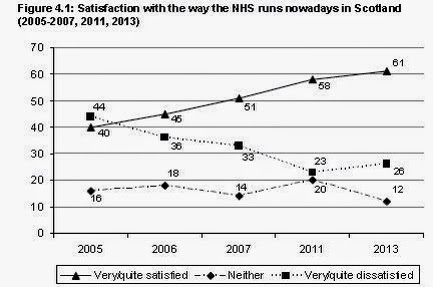
New findings from the Scottish Social Attitudes Survey (SSAS) 2013 have found satisfaction with Scotland’s NHS increased by over 20 per cent since 2005. The official survey of around 1500 Scots found that 61 per cent of people in Scotland were either very or quite satisfied with the NHS, compared with only 40 per cent in 2005. This high level of satisfaction is reflected in the patient experience as well. In last year’s Health and Care Experience Survey, 85 per cent of Scottish inpatients say their overall care and treatment was good or excellent, and 87 per cent also rated the overall care from their GP surgery as good or excellent too.

The survey authors also speculate that the reduction in NHS satisfaction levels in the UK since 2011 may be due in part to concerns about the organisational reforms in the English NHS following the introduction of the Health and Social Care Act in 2012

Scots also continue to reject the marketisation of care. In this survey, the majority of people (59 per cent) also thought the government would provide better quality care services than the private sector. There has even been a drop in support for charities running care services. It was always low for hospitals and very low for the private sector. Private sector involvement in the NHS may be minimal in Scotland, but it is common in the social care sector, particularly residential and home care.

This survey shows that opposition to the marketisation of health and care remains strong in Scotland and that most Scots believe that cooperation is the best way to run our NHS.


Wednesday, May 14, 2014

Pfizer, AstraZeneca and why we need a publicly owned pharmaceutical option

As a biomedical scientist myself, I was very interested to see that the US pharmaceutical giant Pfizer is trying to take over the UK pharmaceutical giant AstraZeneca. As a skeptical socialist I assumed that the reason behind this was to take advantage of our corporation tax rate of 21% which is substantially lower than the US rate of 35%. However, what really got my attention was that policy makers are worried because they understand that if this deal goes through, the UK would lose one of its few world-class companies and more specifically its jobs and investment. This seems a well founded worry as Pfizer reduced R&D expenditure from $9.4 billion in 2010 to $7.8 billion in 2012 and involved the infamous closure of its laboratories in Sandwich, UK.

However, I see a much bigger problem in investment across the whole pharmaceutical sector caused by excessive financialisation. Fuelled by the perception that corporate reorganisation could provide quick returns for shareholders, pharmaceutical companies have attempted to increase profits through mergers, acquisitions and tax evasion, with the net effect of a reduction in total expenditure on R&D. In fact when Imperial Chemical Industries (ICI) demerged in 1993, the pharmaceutical business was merged with the Swedish company Astra to form AstraZeneca but the chemicals and electronics successor companies carried out R&D at a much reduced level.

My argument is that successful, long-term R&D, which produces pharmaceutical products that benefit society and contribute to long-term economic growth, lowers profit in the short term but then provides income streams to fund further research and growth in the long-term. It is not even the case that investors could claim that, the pharmaceutical sector has not consistently delivered high margins and high growth. However, the market failure here is why I feel we need to create a publicly owned option.
Science policy is very political and ideas that can be traced back to Friedrich Hayek float around suggesting that science is a force that cannot be steered and evolves in response to the demands of the market, in an almost Darwinian manner. I admit that this is probably the case in R&D with low barriers to entry, like someone in their bedroom developing an app for a mobile phone. However, it takes on average 9 years and $2.17 billion of R&D spending to produce a single new drug (including the cost of all the failures) in the pharmaceutical industry.

Industrial policy fell out of fashion in the Thatcher revolution, however, post-Thatcher I would really like us to start making a case that the pharmaceutical sector should be planned and directed towards growth and solving the problems of society. Successive governments have asserted the promotion of economic growth as the primary goal of science policy and that is fine but in the past the state has sponsored companies like ICI with guaranteed contracts or monopolies.

The outlays for start-ups in this sector are huge and venture capital money is hard to get. There is also too much focus on the role of small and medium sized enterprises (SME) to drive innovation and in the UK only 3.5% of R&D was carried out by the independent SME sector. Large organisations are required.

The state and the non-profit sector provide massive amounts of R&D funding which largely goes to universities. We can attempt to correct market failure by giving money to companies, through R&D subsidies, tax concessions, patents or even cash prizes but at the end of the day, the state is supporting expenditure that the companies should be making anyway and there is no guarantee that the UK will retain benefit.

Resistance to innovation also comes from representatives of incumbent economic interests.
Incumbent capitalists have lower incentives to invest in R&D than new entrants as innovation causes a lowering of profits from their existing businesses. Perhaps our political system that gives excessive weight to the holders of economic power, is putting a brake on R&D even though it would be beneficial for society?

The fundamental problem is that the social value of producing new drugs does not correspond with their market value, so there is no financial reward for undertaking the R&D that society needs. I personally feel that the state should directly commission the R&D that society needs but the neoliberal dogma is that governments ‘can’t pick winners’. However, I feel that answer lies not in a board of ex-ministers, peers and professors but in an open question to citizens about what innovations are needed? Yes, choices should be underpinned by evidence and include expert advice but democracy should be at the centre of what kind of future people want and what resources we put in to get there.

Our changing age demographic and life expectancy is greatly welcomed and I feel if asked, citizens would like greater resources concentrated towards the ends of their lives. Dementias have no effective treatment and leave increasing numbers of our population and their relatives and carers suffering. It is in this context that the reduction in R&D in the pharmaceutical industry is particularly worrying.

In conclusion, if the government is able, it should stop Pfizer taking over AstraZeneca. However, that still does not tackle the greater problem of the reduction of R&D within the pharmaceutical industry. For years they have generated huge profits by patenting state subsidised research and selling it back to the healthcare system at a profit. The pharmaceutical industry – like the banks - is too important to fail and in capitalist hands, we see the results of short-term profit-maximising corporate interests. That is why we need a publicly owned option. However, we all know that our coalition government is not interested in building an industrial strategy but purely in its strategy of lowering tax.

Scott Nicholson
Tuesday, October 1, 2013

US Government shutdown shows why we should reject private health

The US government shutdown should remind us of the power of the US private health care lobby and why we don't want it here.

I was listening to an American political analyst on the radio this morning commenting on the US Government shutdown. This astonishing mess is caused by the Republicans wanting to shut down Obama's modest health care reforms, before they even start. He starkly described the USA political system as being as dysfunctional as Italy.

That may well be true, but for me it demonstrated something else about the US political system - the lobby power of the private health care lobby. A few years ago we sponsored a showing of Michael Moore's film 'Sicko' at the Glasgow Film Theatre, followed by a debate on healthcare. We had politicians from all the political parties on the panel, but they all agreed on one thing - thank god for the NHS!

This film shows just how powerful the lobby is in protecting their massive profits that results in the most expensive health care system in the world. Billions spent on administration rather than care - a system that excludes millions from health care and bankrupts even more. Health bills are the major cause of bankruptcy in the USA. My favourite clip is Moore taking public service workers, including firefighters who survived 9/11, to Cuba to get free health care that they couldn't get at home.

So why does this matter in the UK. Well in England the NHS is moving rapidly in the same direction. Under the guise of competition, the English NHS is allowing the very same health care corporations to get a very big foot in the door. Once there, they will defend their profits in same way as they do in America. The Tories will be bought and paid for, just as the Republicans are in the USA.

In Scotland, we should be very grateful for devolution and the political consensus on the NHS. We resisted the New Labour reforms  and scrapped the Tory trust model that placed marketing managers before nurses. The political consensus has largely held, to the level that commercialisation is actually unlawful in some circumstances. Private contractors have largely been banished and services brought back in house, reuniting the health care team. Only the CBI is left arguing for privatisation, an issue I was sparring with them over at the Health Committee last week. Even they are largely going through the motions at the behest of English member companies. The only significant blemish is the PPP hospitals and community facilities that waste scarce £millions every year. Sadly, they are likely to do so for years to come as the SNP introduce new PPP schemes through the hub Initiative and so called NPD model.

Of course we are not entirely exempt from the consequences of Tory NHS privatisation in England. The aim is to cut spending and that has a knock on effect on Scottish budget allocations. That's why Scots joined their colleagues in Manchester on Sunday in the largest demonstration Manchester police had seen for a generation.

So when we look in astonishment as the richest country on the planet closes down its government. Remember that the cause is private health care corporations and their lobbying muscle. Then vow to redouble our efforts to campaign against it happening here.

Monday, September 3, 2012

Reform Scotland and GP services

Dave Watson on Reform Scotland's report on GP services.


I was intrigued by the Sunday media warm up to today's launch of Reform Scotland's latest report on GP services. GP's should have better web sites, well that's probably true, even if perhaps not the greatest challenge facing primary care at present. Even a suggestion that all GPs should be salaried. Dangerous socialist thinking here, straight from the SHA policy manual. Certainly not what we expect from the right wing marketeers at Reform Scotland.

However, I needn't have worried. The report itself is full of the predictable market led solutions that you would expect from Reform Scotland. An organisation whose objectives are the apparently,  traditional Scottish principles of limited government, diversity and personal responsibility". Translated this means- small state, privatisation and blame the poor!

The report's recommendations focus on extending GP catchment areas and allowing new GP practices to open. This will apparently create competition with better opening times and websites. And here was me thinking that patient care was the first concern of service users!

The wicked Scottish Government ban on commercial GP providers must of course be ended. After all are not GPs themselves private providers? Well yes they are, a hangover from the 1948 compromise, but that doesn't mean we make the position worse by importing rapacious privateers with profit as their only motive. I just wonder if Serco has made a donation to Reform? Not of course that Reform Scotland needs any encouragement to promote the influence of privatisation companies.

We can of course agree that GP practices should have a decent website and opening times could be more flexible. I don't in principle have a problem with a Scottish GP contract and I agree that health boards should be more democratically accountable. The SHA have strongly supported direct elections for this reason.

However, this report is very clearly focused on introducing a market approach to NHS Scotland on the Tory, English model. Planned services are the best approach to primary care provision, rather than wasteful competition that would lead to marketing managers replacing practice nurses. The relationship with a GP and their staff can be a very personal one and we dont want that compromised, any more than it already is, with the current commercial element. We have seen with privatised occupational health services the role commercial pressures can play.

SHA Scotland has long argued that we should indeed go in the opposite direction, through the introduction of salaried GPs. Many doctors working in primary care would welcome this as their focus, unlike Reform Scotland,  is on the patient not running a business.